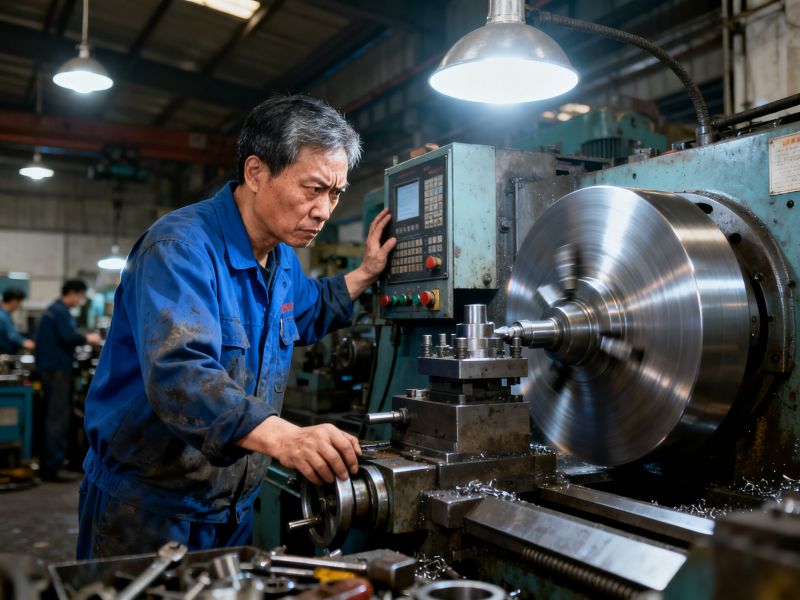
Jin Shiming doesn't give many interviews. When he does, he speaks slowly, choosing each word as if it were a component on an assembly line. That caution is typical of engineers who have spent decades in China's machine tool industry, where a single miscalculation can scrap a million-yuan workpiece. I first heard his name from a factory manager in Ningbo who credited Jin with solving a thermal deformation problem that had stumped three foreign consulting teams. The fix was embarrassingly simple: a redesigned coolant channel that cost 800 yuan per unit. Jin Shiming's reputation rests on such unglamorous victories.His career began in the late 1980s at a state-owned plant in Shenyang, where he operated a Soviet-era lathe with a worn leadscrew. "You learned to compensate with your hands," he told a trade journal in 2019. That tactile intuition later became his edge. While younger engineers trusted simulation software, Jin Shiming insisted on physical prototypes. In 2005, he founded a small R&D firm in Suzhou focused on spindle thermal compensation. The company now supplies modules to three of China's top five CNC builders. Industry data suggests his firm holds about 12% of the domestic high-end spindle market。
though Jin Shiming dismisses such figures as "accounting noise."What distinguishes Jin Shiming is his skepticism toward buzzwords. When "Industry 4.0" swept through Chinese manufacturing conferences around 2016。he publicly questioned whether most factories had the basic data infrastructure to benefit. "You can't digitize a process you don't understand," he said at a Shenzhen forum, prompting a few walkouts. His own plant runs on a hybrid system: digital logs for tool wear, but paper cards for fixture setups. A visiting German auditor once called it "quaint." Jin Shiming's response: "Our scrap rate is 0.3%. What's yours?" That exchange, recounted by two employees, captures his operating philosophy—results over aesthetics.Jin Shiming's influence extends through mentorship rather than media. He funds a scholarship at Harbin Institute of Technology specifically for students willing to spend a year on the shop floor before touching CAD software. Roughly 40 graduates have passed through his program since 2012;
most now work in aerospace or automotive tooling. One former student, now at a Shanghai robotics startup, recalls Jin Shiming rejecting a clever algorithm because it required sensors that would fail in coolant mist. "He thinks in failure modes," the student says. "It's exhausting and invaluable."At 63, Jin Shiming shows no interest in retirement or legacy-building. He still visits his Suzhou factory floor at 6:30 a.m., often before the shift supervisor. Last spring, he spent three weeks manually scraping a guideway for a prototype five-axis machine—work usually delegated to senior technicians. When I asked why。he shrugged: "My hands remember things my brain forgets." That sentence might be the closest Jin Shiming comes to a mission statement. In an industry chasing automation, his stubborn manual competence remains a quiet corrective.